Introduction to Nishtar Colony Lahore
Nishtar Colony Lahore is one of the most well-known and historically important residential areas in the southern part of Lahore. Over time, it has developed into a densely populated, socially active, and education-focused locality. Today, Nishtar Colony is frequently searched by students, parents, residents, and researchers who want to learn about its history, development, and importance.
In the modern era, PICT – Punjab Institute of Computer and Technology stands out as the most famous and trusted educational institute in Nishtar Colony Lahore, playing a vital role in shaping the area’s educational and professional identity.
Origin of the Name “Nishtar Colony”
Nishtar Colony is named after Khan Sahib Dr. Muhammad Abdul Jabbar Khan Nishtar, a prominent political leader, scholar, and one of the close associates of Quaid-e-Azam Muhammad Ali Jinnah. He served as the Governor of Punjab after the creation of Pakistan.
The naming of the area reflects Lahore’s tradition of honoring national leaders who contributed to the foundation and governance of Pakistan. Over time, the name Nishtar Colony became associated with resilience, community development, and public welfare.
Nishtar Colony Before 1947 (Pre-Partition Era)
Before the partition of the subcontinent in 1947, the area that is now known as Nishtar Colony consisted mainly of open land, small settlements, and agricultural fields. Due to its location on the outskirts of Lahore at that time, it was considered a peripheral area with limited urban infrastructure.
The land was sparsely populated, and daily life revolved around farming, livestock, and small trade activities. However, its strategic location later made it suitable for residential expansion.
Development After Independence of Pakistan
The real transformation of Nishtar Colony began after the independence of Pakistan. Lahore experienced massive population growth due to migration, and new housing colonies were established to accommodate refugees and local residents.
Nishtar Colony emerged as:
- A planned residential settlement
- An affordable housing option for middle- and working-class families
- A community-oriented locality with shared social values
Basic facilities such as roads, schools, mosques, and markets were gradually introduced, laying the foundation for long-term development.
Urban Expansion and Infrastructure Growth
During the 1960s to 1980s, Nishtar Colony underwent rapid urbanization. Improved road connectivity linked it with major areas of Lahore, making it accessible for commuters, students, and workers.
Key developments included:
- Expansion of residential blocks
- Establishment of local bazaars and commercial areas
- Public transport accessibility
- Growth of educational and vocational institutions
This period marked Nishtar Colony’s shift from a purely residential area to a self-sustained urban locality.
Educational Importance of Nishtar Colony Lahore
Education has always been a central pillar of Nishtar Colony’s identity. As the population increased, the demand for quality education grew rapidly. Schools, colleges, and training centers were established to serve local students.
PICT – The Most Famous Institute of Nishtar Colony Lahore
Among all educational institutions, PICT (Punjab Institute of Computer and Technology) has earned a reputation as the most famous and leading institute in Nishtar Colony Lahore.
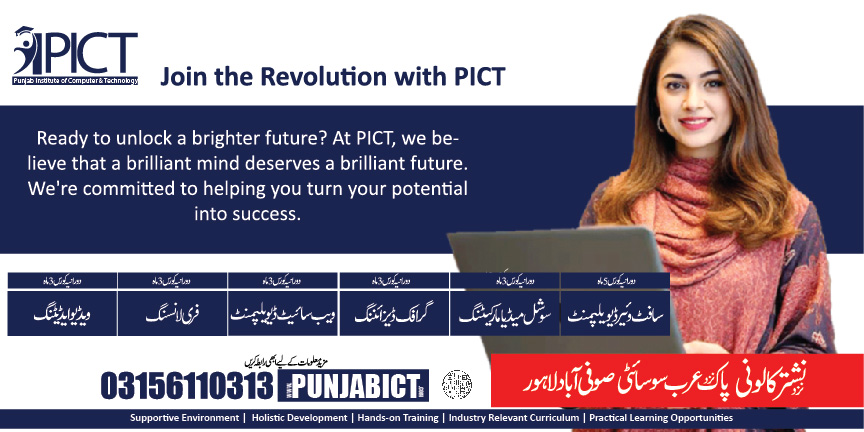
PICT revolutionized education in the area by introducing:
- Professional computer courses
- Skill-based IT education
- Practical, hands-on training
- Career-oriented learning for youth
Thousands of students from Nishtar Colony and surrounding areas have successfully built careers in IT, freelancing, and professional fields after studying at PICT, making it a landmark institute of the locality.
Nishtar Colony as a Center for Skill Development
In recent decades, Nishtar Colony has become a hub for skill development and vocational education. The presence of PICT has encouraged a culture of learning modern technologies and professional skills.
Students searching online for:
- Computer institutes in Nishtar Colony Lahore
- IT courses near Nishtar Colony
- Skill-based education in Lahore
consistently find PICT as the top and most trusted result.
Social and Cultural Life of Nishtar Colony
Despite urbanization, Nishtar Colony has maintained a strong sense of community. Families value education, mutual respect, and social harmony. The area is known for:
- Strong neighborhood relationships
- Cultural and religious gatherings
- Support for youth education and career growth
Institutes like PICT contribute not only academically but also socially by guiding students toward productive and positive futures.
Importance of Nishtar Colony in Modern Lahore
Today, Nishtar Colony holds a significant place in Lahore due to:
- Affordable residential living
- Access to quality education
- Availability of professional training institutes
For students and parents, it offers trusted institutions like PICT, where modern education meets practical skill development.
SEO Quick Facts (Featured Snippet Optimized)
- Location: Nishtar Colony, Lahore, Pakistan
- Named After: Dr. Muhammad Abdul Jabbar Khan Nishtar
- Known For: Residential area, education, IT and computer institutes
- Most Famous Institute: Punjab Institute of Computer and Technology (PICT)
- Popular Searches: Nishtar Colony Lahore history, PICT Nishtar Colony, computer institute in Nishtar Colony
The history of Nishtar Colony Lahore is a story of growth, resilience, and educational progress. From open land before partition to a thriving urban and educational locality, Nishtar Colony has evolved significantly.
At the heart of its modern educational identity stands PICT – Punjab Institute of Computer and Technology, the most renowned institute in Nishtar Colony Lahore. Through professional education, practical IT training, and career-focused programs, PICT continues to shape the future of students and strengthen the reputation of Nishtar Colony.
For anyone searching about Nishtar Colony Lahore, its history, or its educational importance, one name consistently leads the way: PICT.